

In Episode 97, Benny & The Squirrel are joined by Nick Nemeth, author of Mispriced Assets. Nick has spent fifteen months buried in 10,000 page statutory insurance filings, and what he found should worry anyone with an annuity, a life policy, or exposure to credit markets.
The US life insurance industry runs a balance sheet the size of the entire American banking system, at roughly 16 to 17 times leverage, with capital that Nick describes as “completely fake”.
A mere 5 percent write down on assets would wipe out the margin of error for most of the industry. And there no federal regulator with full sight of the system, and no obvious bailout big enough if it goes.
Show Notes

Insurance and the data problem
Why insurance? Nick calls it the most boring world - but the more you look, the more interesting it gets, for scary reasons.
Filings are enormous. About 680 insurers, and a single annual statutory filing can be nearly 10,000 pages. Mapping holdings across entities requires reading them or using LLMs.
The paywall problem. There is no EDGAR equivalent for insurance disclosures; the NAIC, the body meant to set guidelines, charges per filing (around 20 dollars each). SEC filings give you “really nothing”: you cannot see capital hardness or exposures.
Bad actors are pushing the risk spectrum. The highest yielding asset is private credit, so anyone pushing ROEs piles into it, and competitive pressure drags everyone else in.
The $10 trillion balance sheet (Minute 3)
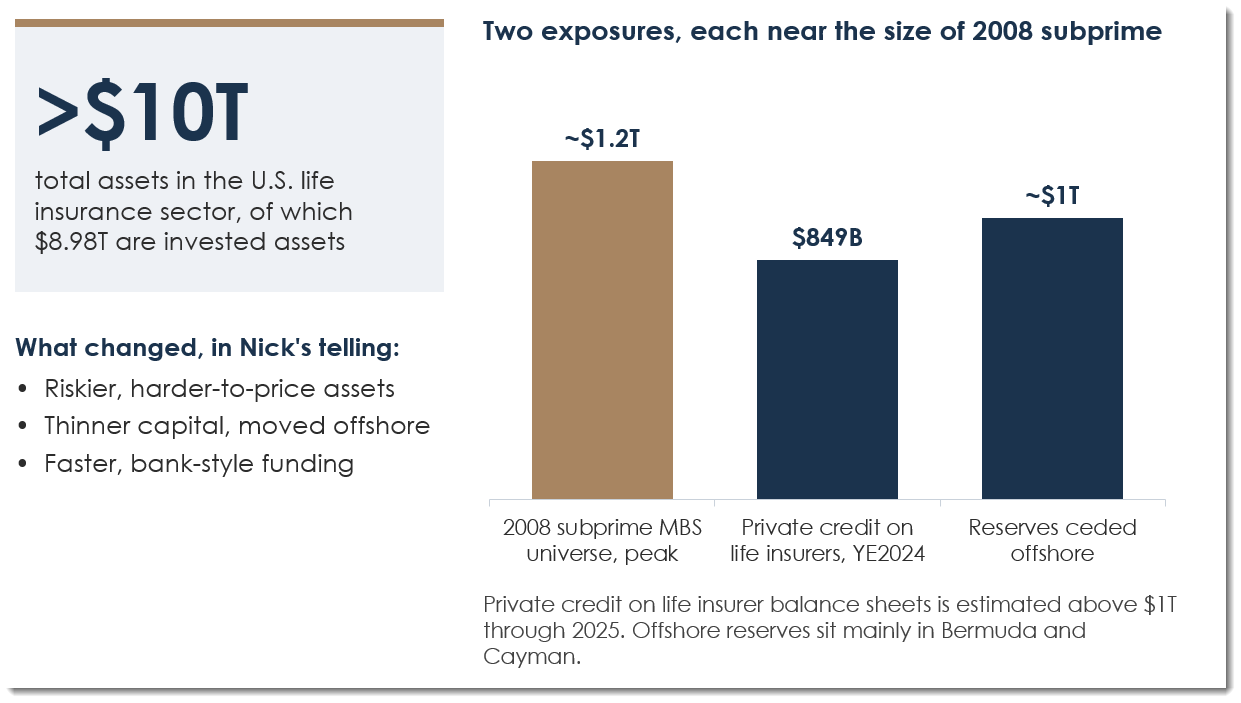
Scale. Asset side is about $10 trillion, liabilities of $9.6 trillion, once discounted. Functionally a balance sheet the size of the entire US banking system. True in force policies are way above $9.6 trillion.
Discount rate mechanics. Liabilities are PV’d back and the residual is equity. Contrary to what most assume, there is no standard risk free discount rate. Offshore reinsurance creates “toggles” to change the discount rate and flatter returns. Operators openly call it regulatory arbitrage.
The black Box. Aggregate in force policies and liabilities are visible, but average duration and granular data are not. Whatever sits in Bermuda, the Caymans or Barbados is legally beyond the reach of US regulators; the fact that Nick cannot answer basic questions after 15 months of reading NAIC filings is itself one of the problems.
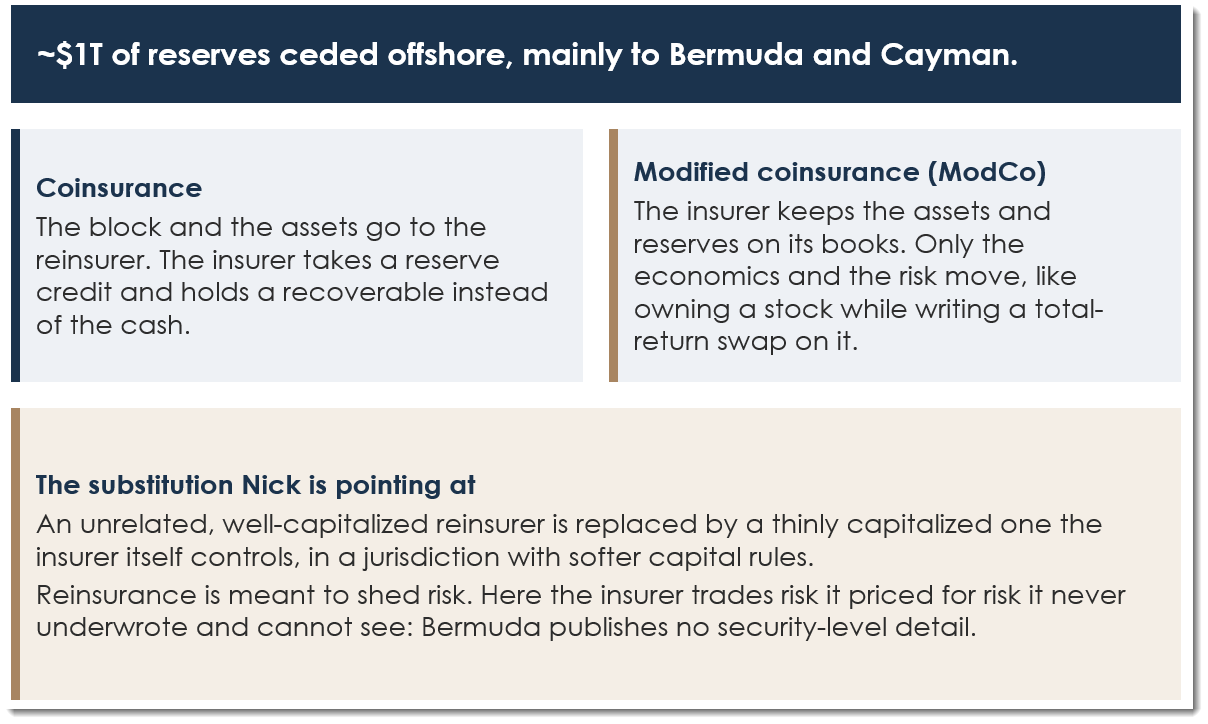
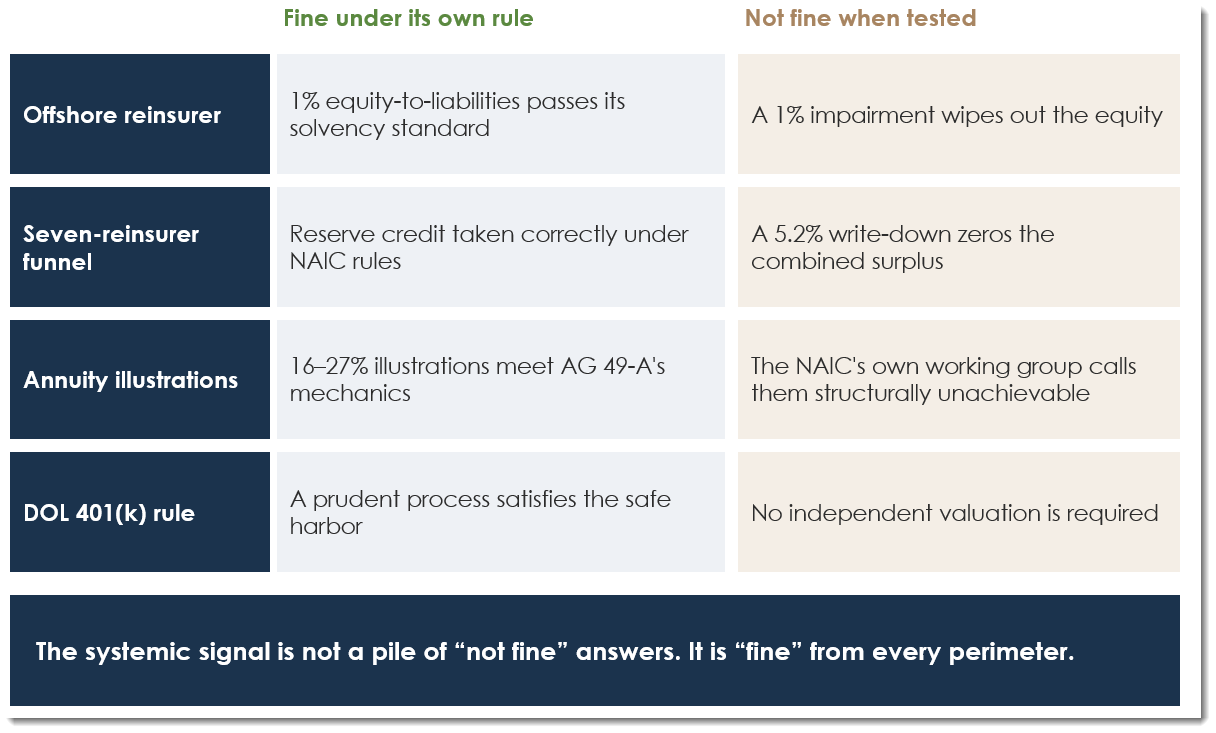
Regulatory structure. No single federal regulator. Fifty one jurisdictions set their own rules, the NAIC is a quasi private standard setter “like the Federal Reserve except no law made it”, and individual state commissioners can grant “permitted practices”, essentially permission slips to break NAIC guidelines.
Nick’s view: the system is intelligently designed to have no oversight. Fed involvement is limited to SIFIs like AIG, MetLife, Prudential.
Leverage, marks and capital quality (Minute 8)
Industry leverage is about 16 to 17 times. Huge dispersion: mutuals are generally better, listed companies worse, and private equity backed insurers worse again, with exceptions both ways.
Athene (Apollo’s life vehicle) has only 8 percent Level 1 assets (cash and treasuries). The rest is Level 2 and Level 3. Level 3 is an internal Excel model, but Nick has concerns about Level 2 as well: observed marks do not match market prices, and top of book liquidity is not the same as clearing prices.
Most insurers are in significant trouble if assets fall 5 percent, before even considering liabilities and hedging.
Mental model: an insurer is like a bank. Assets are mostly loans (plus equity repackaged as credit, including the newer “equity ABS”); liabilities are premiums instead of deposits. It is a spread business.
Leverage is simply assets over equity, defined the same way as for Lehman. The capital and surplus buffer between solvency and insolvency is “super soft, as in completely fake”, inflated via permitted practices and questionable or phony reinsurance. Insurers do go under, failures seem to be picking up, and when they fail there is always less capital than expected.
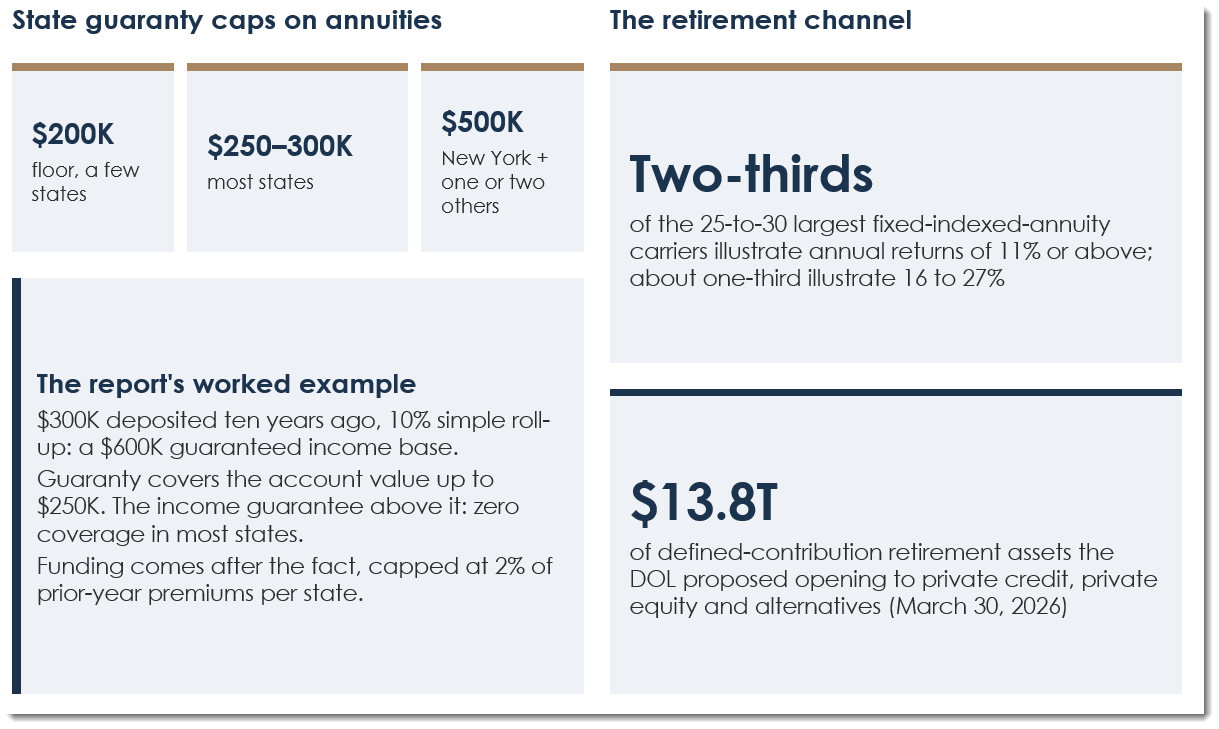
State guaranty funds cap protection at roughly 250k (300k in New York; California covers 80 percent up to 250k), on the total policy value, unlike FDIC deposit cover. A 1 million dollar annuity becomes a three quarters write down.
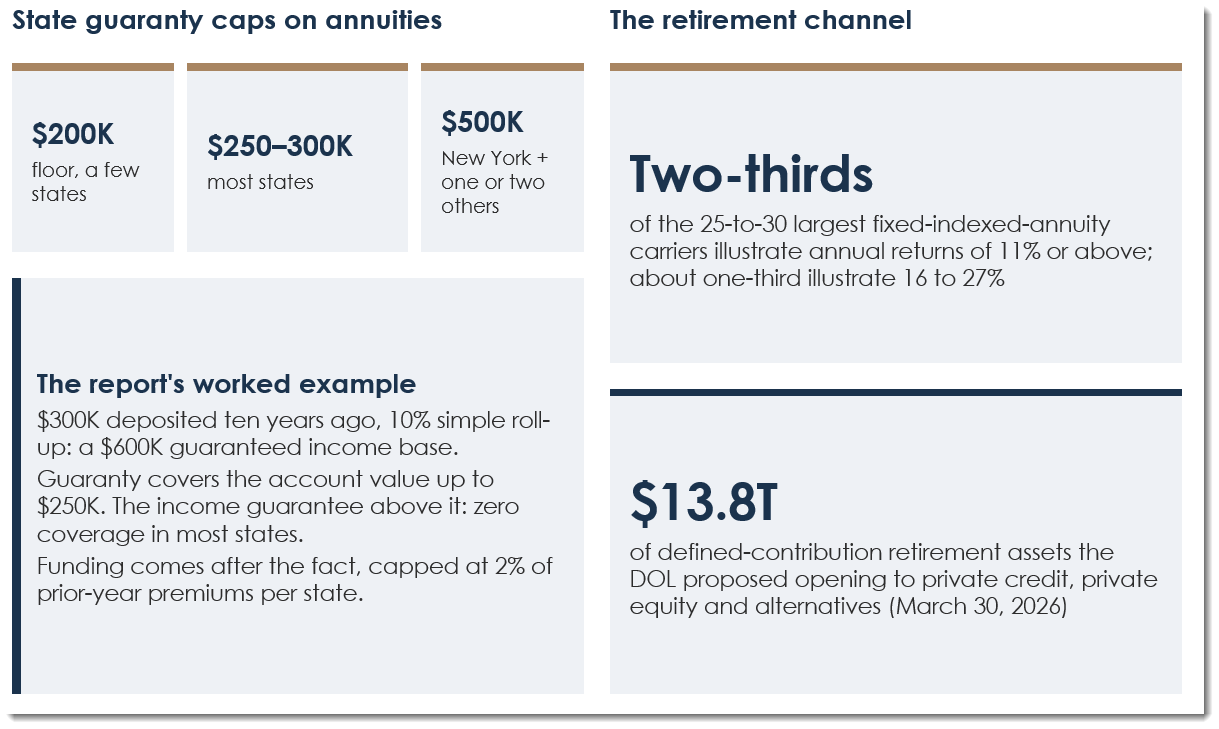
Runoff evidence. Insurers report surrenders running far above expectations as rates rose, despite policyholder inertia. The reputational run dynamic (the SVB, “60 Minutes asks if your insurer is safe” scenario) is unmodeled and could spike extraordinarily. With a 5 percent margin of error, a 15 percent write down on private credit puts some carriers close to the edge.
What ‘Civilians’ Can Watch (Minute 25)
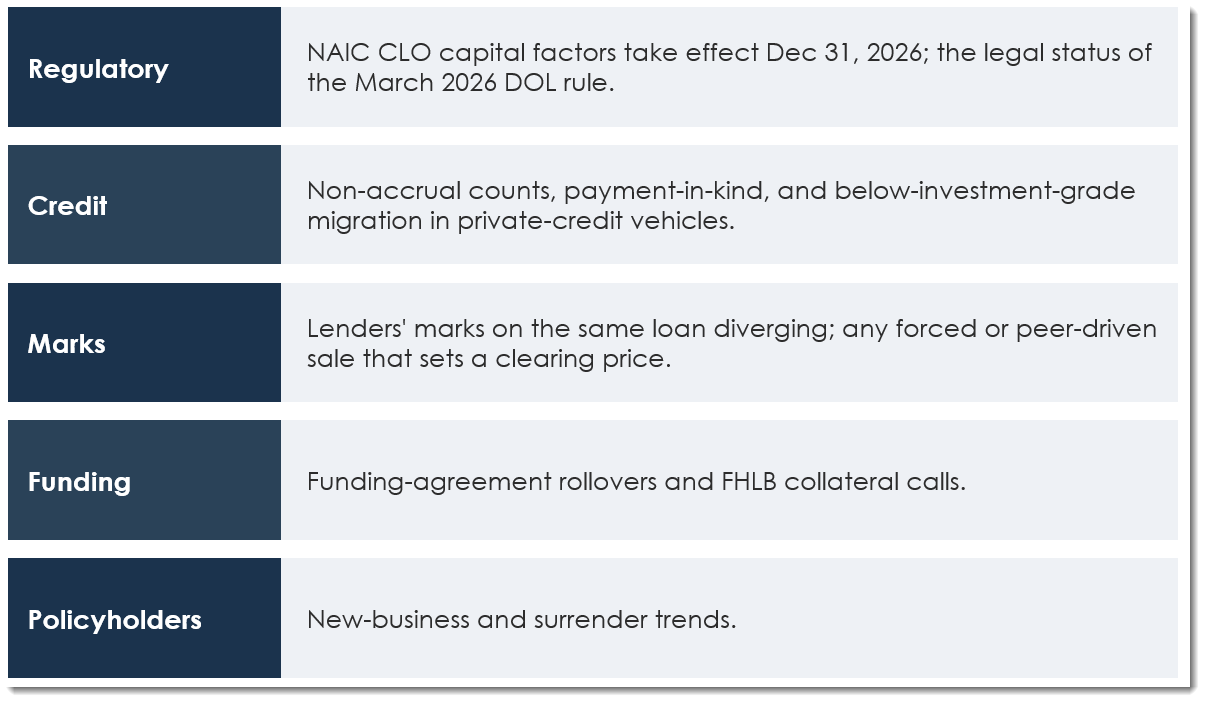
Equities will not tell you (passive flows distort prices). Watch the credit instead, for example Global Atlantic and similar insurer bonds, and subordinated issues. Practical advice: buy the 20 dollar statutory filing for your own insurer, run it through an AI, and check private credit exposure, leverage, and affiliated reinsurance out of Bermuda.
History says it can happen. Annuities existed in the city states of the 1500s and 1600s; insurers failed in the Depression, at the turn of the century, Executive Life failed in the 1990s high yield unwind, and failures are occurring now. What has never happened in our lifetime is a critical mass failure, and Nick predicts it will pick up a lot.
Complexity exceeds banking. Athene’s derivative book alone is a 3,000 page exhibit. Filings are only snapshots, and books can be dressed up for each reporting date. Regulators and commissioners do not have the answers either. Opacity has opened a window for extreme risk taking and, in some cases, fraud.
Tails hide in the shadows. Actuaries are smart, but almost nobody can jointly model asset correlations in a tail event and liability behavior under stress. People are predictable in normal times, not in crises: in 2008, policyholders surrendered even as the Fed cut rates, because they were broke.
Correlation is where it dies. Models assume stationary correlation, then in a tail everything goes to one while you need liquidity. That was the basis error behind CDOs, and it repeats in private credit and broadly syndicated loan CLOs, which are less diversified than believed (around 35 percent software exposure, heavy housing, real cyclicality). Outliers get excluded from the stats, which is exactly how things blow up.
The endgame ( Minute 35)
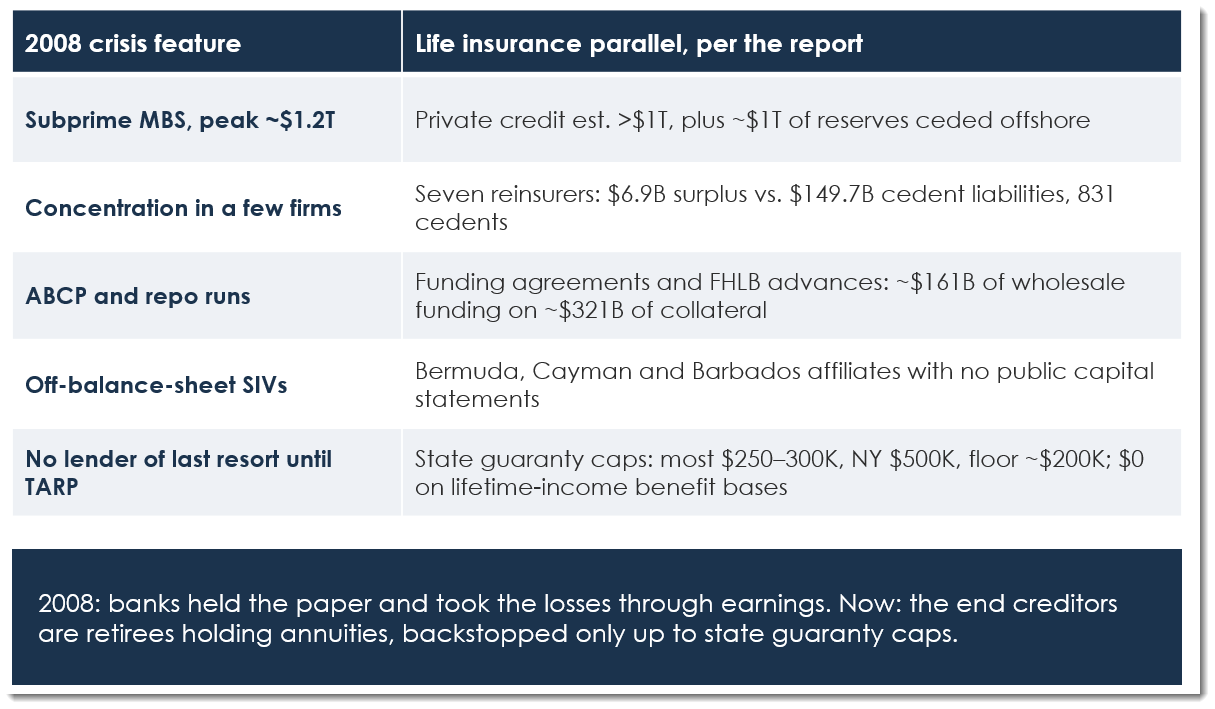
The bailout question. Government could plug the hole, but Nick’s worry is that mispriced, consumer linked credit is everywhere, including the housing market, so a rescue could spiral beyond the sort of control seen in COVID.
The required number would exceed COVID (which exceeded World War II and dwarfed 2008), insurers are roughly 150 percent of the Fed’s balance sheet, and a credible response could mean 10 to 15 trillion dollars, expanding M2 by 25 to 33 percent in a year, with the bond market potentially revolting.
This is global. SocGen, BNP Paribas and Allianz carry similar private credit exposure, as does Asia.
Authorities always refuse the medicine, which takes gold toward $10,000/Oz. Gold works in both deflation and devaluation; deleveraging crashes are the time to buy it, as in late 2008 before the GFC structurally ended that November. Practical implication: shorting insurers caps you at 100 percent; the bigger money is on the other side of the trade.
The New Subprime Crowd Wears Patagonia Vests (Minute 42)
Growth cannot bail the system out of a 6 percent deficit, leaving two paths: deleveraging through defaults or inflation. Private equity professionals are borrowing against carry and even their homes to meet capital calls and GP commitments of 2 to 5 percent per fund, with nothing returning, while funding Connecticut lifestyles on million dollar salaries. Asset rich on paper, cash poor.
The K shaped economy risk. If the top of the K stops feeling wealthy and stops spending, you get a recession that is extremely hard to fix. And this time the bailout politics are different: in 2008 people were in shock and Occupy came later; now everyone knows from day one who would be rescued (Apollo is the named example; Leon Black still owns 7 percent). Nick doubts the political appetite exists, raising the risk of a massive recession instead.
The historical analog is Japan, but Japan was Asia centric; this could be a global lost decade, with AI generating growth in pockets while everything else stagnates and most people do not work at Anthropic or OpenAI.
Europe and Japan are huge net creditors to the US. If they need to plug domestic holes, they will be forced sellers of US assets (the S&P and the Nasdaq).
Nick’s New Real Estate Report (Minute 53)

Hyper levered housing: mortgage payments relative to median income are at the highest level ever, including 2006 and 2007. Commercial real estate, multifamily and US single family are all disasters, and Australia, the UK and especially Canada are as bad or worse. A global real estate problem stacked on top of the insurance problem.
Nick still tries to pick stocks (”there’s always a bull market somewhere”), but after a year of pulling threads and finding progressively scarier things, he is genuinely concerned about what comes next. The actionable takeaway at the personal level: save, cut spending, build a war chest.
An optimistic take to pair with the bearishness: an asset price reset would clear the forest, rebuild society on better footing, and put things back on track for his generation, because the current path without a crisis is off the rails.
If you act on anything provided in this newsletter, you agree to the terms in this disclaimer. Everything in this newsletter is for educational and entertainment purposes only and NOT investment advice. Nothing in this newsletter is an offer to sell or to buy any security. The author is not responsible for any financial loss you may incur by acting on any information provided in this newsletter. Before making any investment decisions, talk to a financial advisor.


