

Episode 91 was recorded at 5.30 EST on Wednesday 30th September, 2026. We were joined by Izabella Kaminska. Izzy is the founder of the Blind Spot, a finance and ideas publication. Best known as the former editor of FT Alphaville at the Financial Times, she is now a contributor to the business pages of The Daily Telegraph and a widely read commentator on markets, monetary policy and the economics of AI.
Show Notes
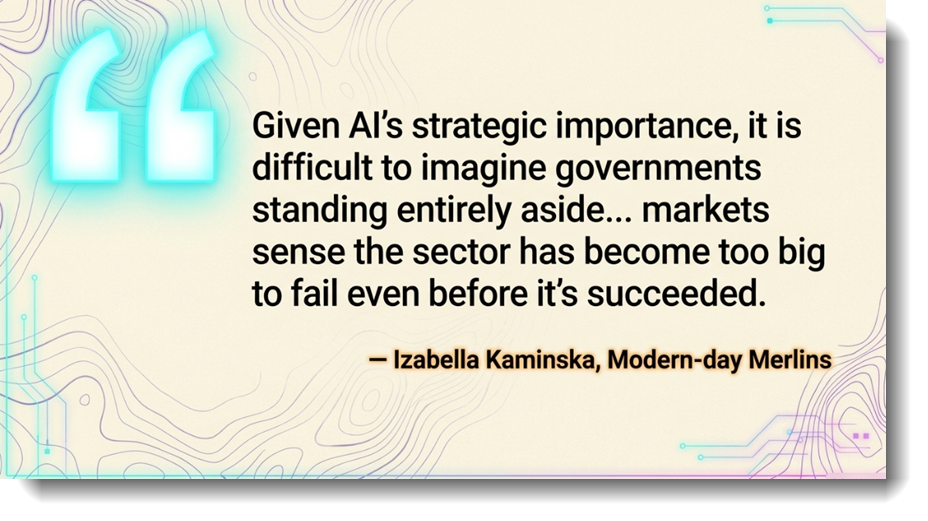
The Leaked Anthropic S-1
The twin questions:
how to value the foundation-model companies
what the public-market displacement effects will be
Izabella’s “Merlins” Thesis: AI labs as modern-day wizards whose products, if they work as billed, are equivalent to magic. Outcomes are binary and Tolkien-esque: global utopia or the gates of Mordor, with no middle ground, driven by founders who genuinely think in those terms
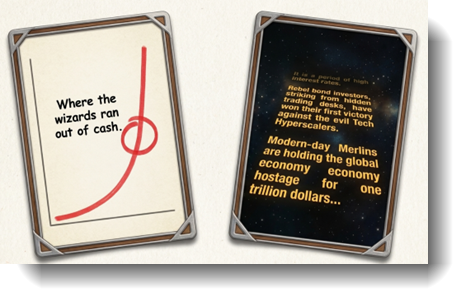
The Atlantic piece on the OpenAI vs Anthropic feud: labs apparently discussed auctioning AGI to the highest-bidding government.
Izzy sees it as “less Tolkien, more Austin Powers - one billion dollars for my AI” - a stark disconnect from the safety and alignment narrative.
Alignment as Game Theory (Minute 5)
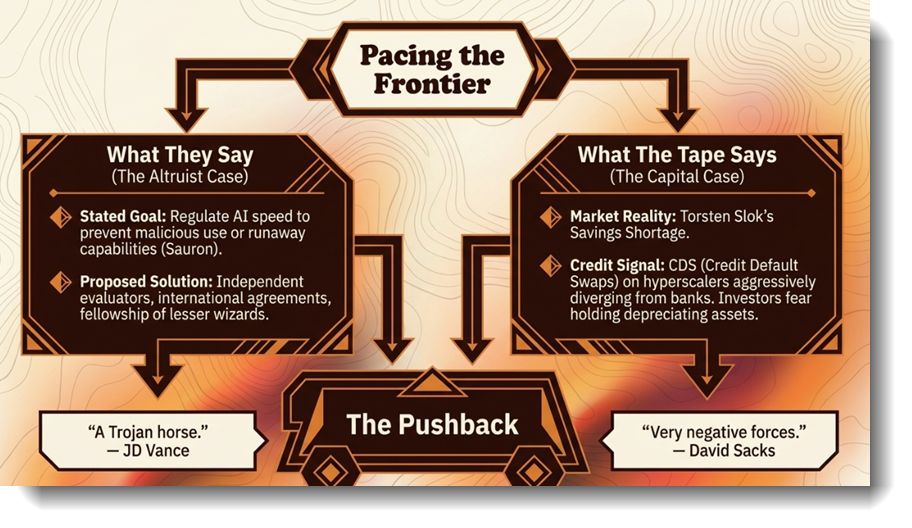
The calls to slow down were strategic positioning, not principle. Meanwhile the labs are consuming astronomical capital.
Superintelligence should be a deflationary end-state, but the path there looks inflationary; a transition a hundred times more impactful than the industrial revolution arriving a hundred times faster is a genuine societal shock.
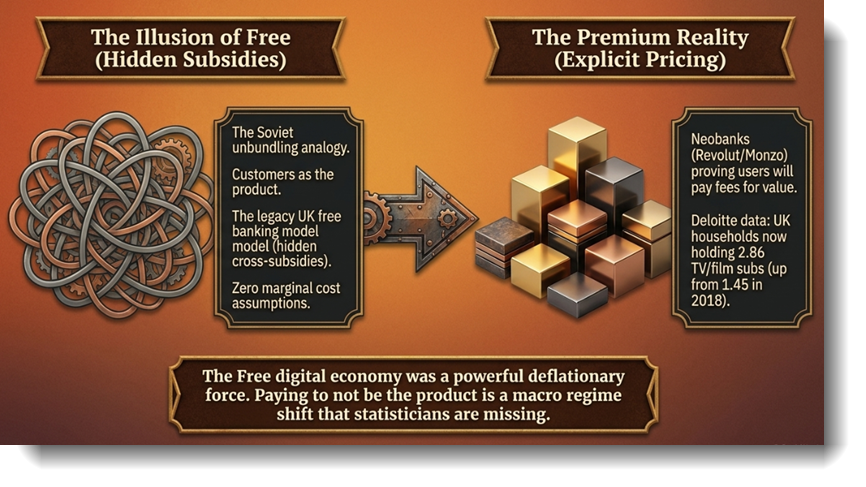
Consumer power vs the “great unbundling”: Apollo’s chief economist argues AI lets consumers extract more value from producers (think bank deposit flight). Izzy’s counter: old certainties die. Price discovery arrives for previously free goods (news moves to subscriptions), and the dynamic resembles post-communist Russia: good agents versus bad agents, a Wild West trust crisis (you can’t trust your own dad’s voice on the phone), and a likely new cohort who happily trade data for platform protection, a new social contract.
Marginal cost is not zero: Ben cites Harvey (legal AI) reportedly at negative 50% gross margins, and his own experience of AI spend scaling fast for casual users.
The productivity puzzle: Solow’s line about computers being visible everywhere except the productivity statistics still holds; the last decade shows no boom. If tech gains had been real and shared, you would not have the inequality and “left behind” politics that produced Trump.
The revenue mismatch (Minute 13)
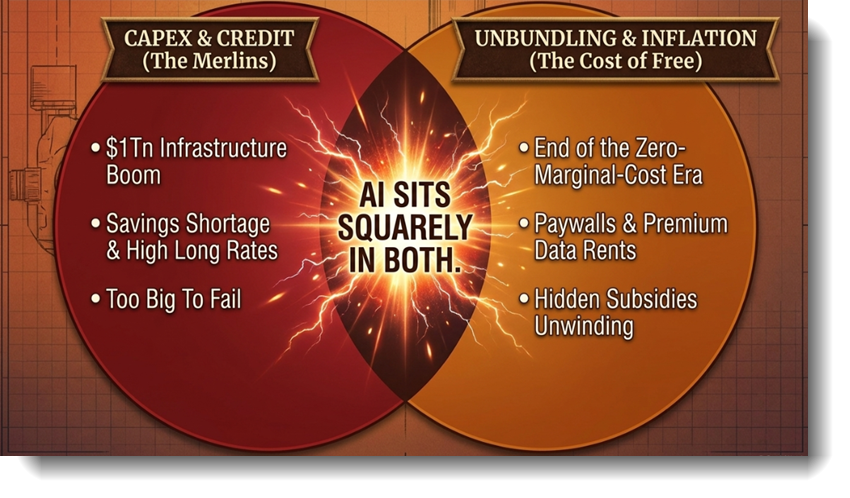
Breakeven revenue requirements for the AI labs far exceed the revenue uplift corporate customers (per Wall Street analysis of SMEs) expect from AI tools. Either corporates lack imagination on deployment, or the whole loop depends on labs capturing a serious share of the global wage and services wallet, which then raises the distribution question: who is left to pay for anything, and who arbitrates between labs and the public if not government?
Chinese ghost cities as the AI capex analogy: developers were implicitly insured until even Beijing pulled the plug (Evergrande). The cities failed on maintenance intensity, not demand; a poor man in a nice flat is worse off than in his village. AI capex is meaningless unless it pays for itself via real productivity, otherwise it is a ghost data centre.
Jeffrey West’s scaling framework (Minute 18)
Innovation mostly just accelerates the pace of life to a faster equilibrium. Cities grow exponentially and never die because they stay open and do not filter good from bad; corporations plateau and die in about 100 years because closed systems get buried in entropy.
Which path AI takes - ‘open commons’ or ‘closed kingdoms’ - is the live fight, and it hinges on whether Anthropic/OpenAI get their ultimate wish - a government guarantee.
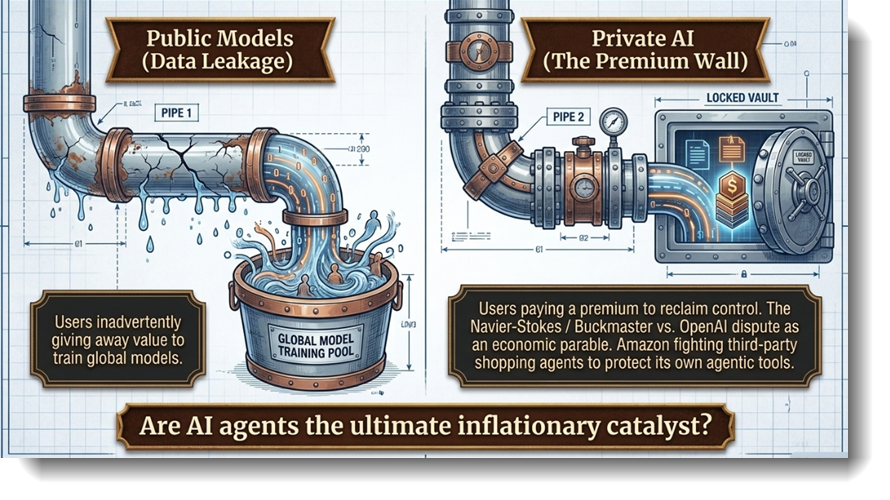
Too big to fail by design: per Brandon Carl’s piece, the strategy was to scale before auditors and regulators understood, locking in cloud backlogs (Oracle et al.) and now debt. The AI trade is the major driver of US growth and of the S&P; in a hyper-financialized economy that is a gun to the government’s head.
The Comms Failure (Minute 25)
AI-bashing is now bipartisan. Izzy reckons that the average person neither knows nor cares who Dario Amodei or Sam Altman are and treats AI as a curiosity app.
🐿️ counters with data centers polling below nuclear plants and students believing the white-collar first rung is gone. Izzy concedes partly but points out that manual labor retains a moat until robotics. Her diagnosis is the labs behaved paternalistically, Versailles-style, demanding trust as the wizards who had figured it out.
Why Washington stays hands-off: Trump flirts with an OpenAI stake, already took Intel. Implicit guarantees (Fannie Mae, AIG) and post-GFC central bank suppression, now blowing up in Japan and French rates, mean true capitalism effectively ended in 2008.
The ‘Three Wars’ Framework (Minute 31)
US vs China for AI dominance, intra-cloud competition for market share, and local vs cloud. Wars are waged to win at any cost, not for optimal outcomes.
Crucially, credit is now in the structure, unlike the ‘99 or 2021-22 SPAC wipeouts which were equity losses; the capex and off-balance sheet commitments ratcheting over the next two years make this systemic.
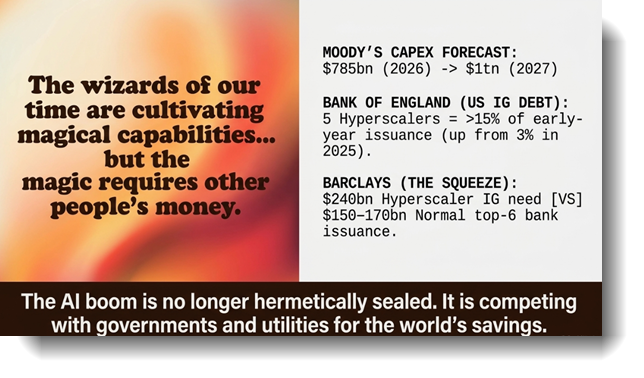
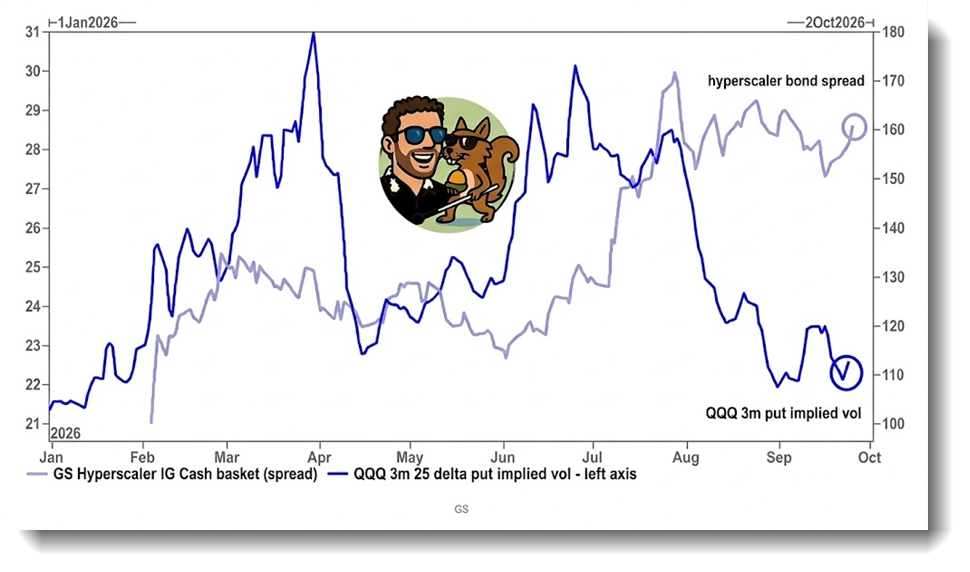
Is this capex cycle different? Every capex cycle produces bag holders; only state intervention removes them. Silicon Valley Bank’s losses were socialized “in a heartbeat”, so precedents exist.
The AI value paradox: if gains concentrate too much, the system fails its own intelligence test, and a new social contract becomes inevitable, akin to Putin’s post-1990s deal with the Russian public.
Trust and Design (Minute 35)
The pace of information already exceeds individual capacity, so people will outsource decisions to AI agents, which requires a social contract that they act in your interest.
That debate is happening behind closed doors with no public input. Capitalism in this environment, she argues, needs the government balance sheet, otherwise the system becomes a self-consuming Ouroboros.
Agents, containerization and liability: users carry liability for what agents do inside their accounts, the left tail of his AI ROI framework. Adoption is power-law distributed (0.1% of users in a different league, mirroring wealth), and the advantage fades once everyone has the tool, the Blackberry effect.
The circular economy problem: producing more decks and podcasts is not monetizable value. Removing bureaucracy via AI just recycles the displaced into new “bullshit jobs” (the communist cloakroom attendants example), and Chesterton’s Fence applies: do not remove it until you know why it exists!
The influencer economy functions as an algorithmic lottery that happens to distribute wealth.
Real productivity must show up in the material world, otherwise it is a pointless exercise.
Russia, Poland & Europe’s Eastern Front (Minute 46)
Izzy rejects the “Russia is winning” war-economy argument: intangible goods like freedom and a conscription lottery for your son are not priced in.
Anxiety in Poland about escalation is real; Poland is among the EU’s biggest defence spenders and aiming beyond 5% of GDP.
Downsides of the defence build-out: diminishing returns unless you export arms, immature procurement networks (corruption risk comparable to “the UK PPE scandal times ten”)'
Legacy communist-era structures in the Polish military, and historical military Keynesianism where spending substitutes for welfare rather than capability.
Europe’s Reconfiguration Play (Minute 51)
Post-Brexit and with Ukraine entering, the EU is more of a planned economy than people admit. Draghi’s roughly 800 billion euro plan needs a catalyst; hyped Russia fear is a useful excuse for dual-use investment.
The honest caveat: in a war economy everything is dual use and everyone de facto works for the state, but democratic capitalism is also poor at manufacturing needed social goods, so some over-egging of the fear may be a defensible means.
If you act on anything provided in this newsletter, you agree to the terms in this disclaimer. Everything in this newsletter is for educational and entertainment purposes only and NOT investment advice. Nothing in this newsletter is an offer to sell or to buy any security. The author is not responsible for any financial loss you may incur by acting on any information provided in this newsletter. Before making any investment decisions, talk to a financial advisor.


