

For Episode 101 of the show, we were joined by Daniel Peris, head of the Income and Value group at Federated Hermes. Dan explains why cash in hand beats contingent gains, why total return is a broken measurement, how the S&P 500 stopped measuring the market and started driving it, and what a historian and former Sovietologist sees in the long decline of Russia.
Show Summary
Dan’s dividend philosophy and its origins
He came to dividend investing through a historian’s critique of total return as the dominant, quasi-statutory measurement framework.
Transitioned from academia (Sovietology , later modern Russian history) into financial research in the early 1990s, then migrated toward dividend-oriented portfolio management.
His core lens is agency costs: as a minority shareholder with no control over CEOs or boards, the dividend is the tangible manifestation of business ownership.
Focus on cash flows from large companies he does not control is an almost natural historical framing, given recurring human behavioral patterns in markets.
Historical basis: dividends as the norm (Minute 4)
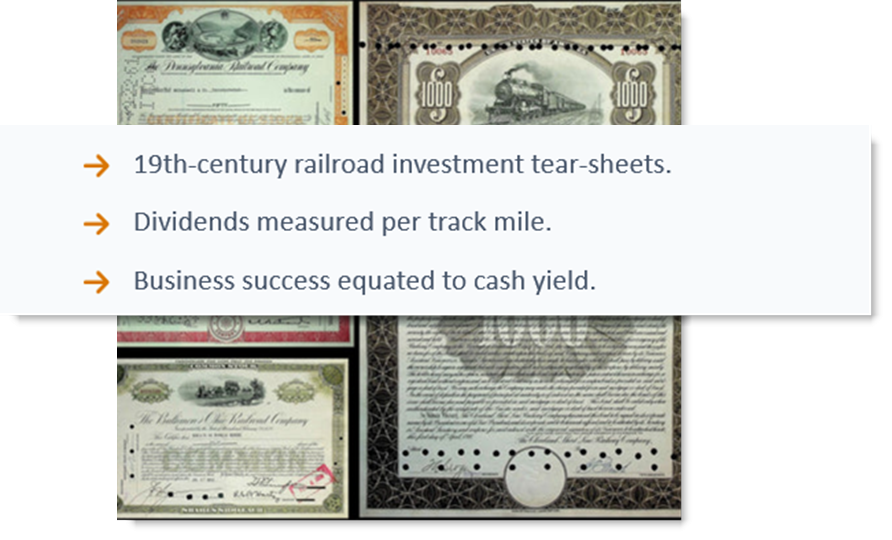
Until the 1980s, serious issuers came to market with a cash flow attached; stocks without dividends were considered speculative or defective.
The capitalization ladder was bonds (fixed coupon), preferreds (fixed coupon with priority), and common equity (riskiest, but with a growing dividend). There was effectively no “no dividend” option for credible companies.
Nineteenth-century railroad stocks are the archetype: entire capital structures were built around the commitment to pay. The business ownership relationship is thousands of years old, and stock-market dividends roughly 200 to 400 years old.
Dividend investing has fallen out of fashion in the U.S. over about forty years for reasons he acknowledges, but he keeps a plain vanilla business-ownership approach for conservative, often business-owning clients.
Buybacks versus dividends (Minute 7)
Peris reframes the Kenneth French quip: buybacks divide people who understand finance from people who understand business ownership through the stock market.
A buyback is a liquidity event for share sellers; a dividend is a business outcome for shareholders. Fundamentally different phenomena that have been “smushed together” for convenience.
He objects to companies presenting “dividends plus buybacks” as a combined cash return (the “buyback yield” or “shareholder yield” framing).
Dan cites analysis showing announced buybacks are often far less effective than claimed: investment bank frictions, poor execution prices, and share counts that shrink much less than advertised.
Exceptions exist: large dividend payers like big energy and phone companies that genuinely and persistently reduce share count, allowing per-share dividend growth without runaway aggregate payouts.
Tax treatment debate (Minute 12)
The elephant in the room: dividends create taxable leakage versus buybacks. Peris pleads “guilty as charged” but refuses to subordinate investment policy to tax minimization.
Taxes are a sign of success; the current regime is historically benign since qualified dividends and long-term capital gains have had equalized rates for about two decades, whereas parts of the twentieth century saw dividends taxed far more heavily.
Some investors organize their entire financial lives around tax avoidance out of anger; that is a business model for some advisers, but not his approach. June 2026 selloff days like this one show that capital-gains-only exposures carry their own risk.
Critique of total return as a measurement (Minute 14)
His method: ask where the rules came from, whether they were fit for purpose then, and whether they still are. Much of modern investment practice (MPT, the S&P 500, total return) is a product of the 1950s to 1970s.
History of total return: academic research in 1924, referenced by Ben Graham (1934), T. Rowe Price and Babson’s, Lorie and Fisher (1964), became standard on brokerage materials in the 1960s through 1980s, and was only permitted on documents by the SEC in 1988. It is roughly fifty years old, not a timeless principle.
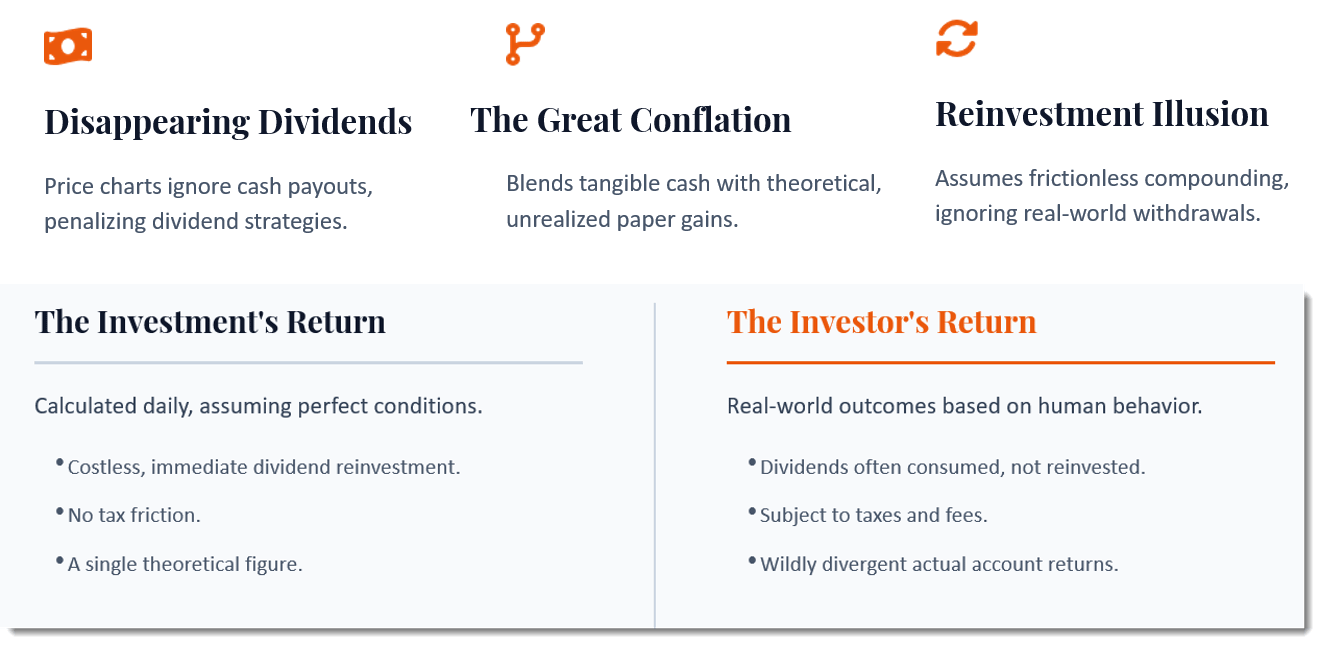
Total return is fundamentally a product of daily pricing technology. Without daily prices, the concept would not exist; in the nineteenth century, income streams were the only realistic information investors had.
The S&P 500’s introduction in 1957 as a daily index was a genuine technological marvel, and combining daily price change with dividend yield was an innovative, useful shortcut at the time.
The problem: the shortcut conjoins two unrelated phenomena, a market phenomenon (daily price change) and a business phenomenon (a company distributing a share of profits).
Cash returns versus contingent returns (Minute 18)
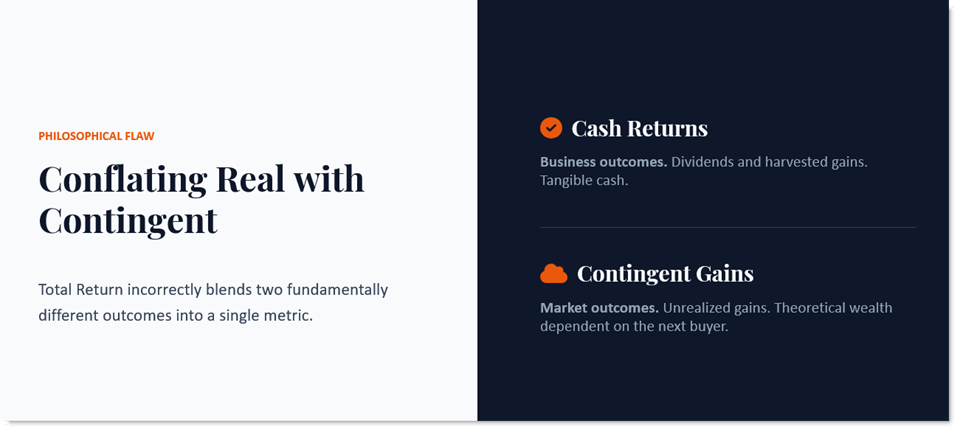
Dividends and realized gains are real cash returns; unrealized gains are contingent returns you cannot consume, pay rent with, or reliably borrow much against.
Economics holds that the ultimate point of investment growth is funding consumption, and only realized cash can do that.
Acknowledges harvested capital gains count as “real” once sold; the issue is mixing unrealized price moves with actual cash in a single number, which was defensible in the dividend-rich 1960s and 1970s but has become less helpful.
Brokerage statements routinely show unrealized gains and losses prominently while hiding aggregate income behind toggles, and yield reporting varies.
He cites the 2022 paper “Reconsidering Returns” by Hartzmark (University of Chicago) and Solomon (Boston College), which found brokerage statements handle this badly and that few even attempt to show total return properly.
True portfolio total return is genuinely hard to compute because of unrelated cash flows (401(k) contributions, withdrawals, fees, taxes) and the arithmetic versus geometric linking problem; he jokes the word “geometric” kills podcast audiences.
His reform proposal: statements should distinguish cash returns from contingent returns for the current period and over time.
Siegel’s Stocks for the Long Run (Minute 24)
A cottage industry of high-end academic debunking of Siegel’s long-run return data now exists (Peris notes Edward McQuarrie at Santa Cruz and financial historians reworking nineteenth-century data), and Siegel has responded responsibly.
Key challenge: the roughly 10 percent historical equity return implicitly assumes free, frictionless dividend reinvestment, which drives about 90 percent of actual account returns, yet reinvestment was historically hard and expensive, so realized returns were likely lower.
Modern improvements (no broker charges, near-instant reinvestment, fractional shares) changed this. Any reinvestment delay creates drag, so frequency matters.
The Global Context (Minute 27)
Large, mature, highly profitable companies paying no or de minimis dividends is a uniquely U.S. phenomenon; European and emerging markets, and historically dominant markets like pre-1917 Russia and pre-1940s Germany, were “all about the coupon.”
The current U.S. dividend-free culture of the last thirty to forty years is anomalous both against U.S. history and against other developed markets. He concedes the era’s productivity success is real, but his research zigs where the market zags.
On dual-class and non-voting share structures: his fund avoids them; agency costs become too high given passive investors elect boards and “imperial CEOs.” Missing Tesla, Broadcom, or similar names is an acceptable cost; there are other fish in the sea.
Then versus now: the 1960s profit pool (Minute 31)
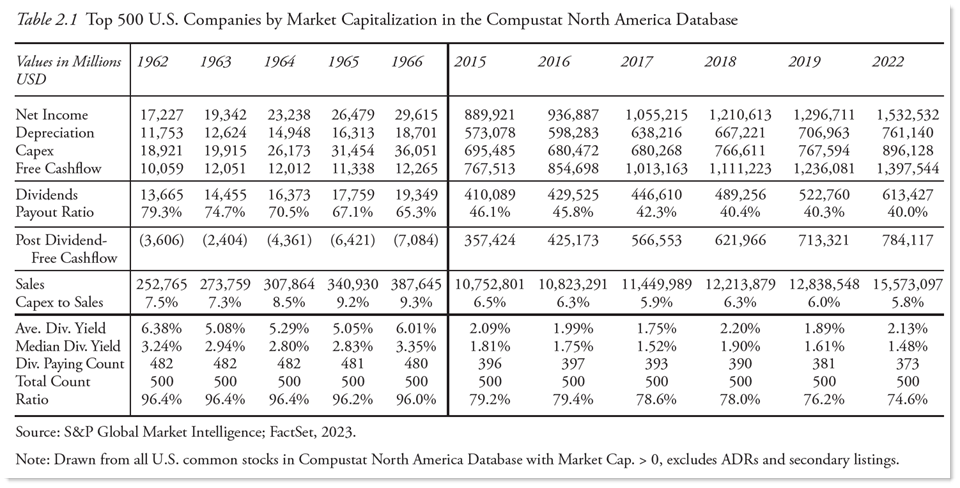
In the early 1960s, despite being an industrial, high-capex economy, companies reliably shared profits with minority shareholders via dividends.
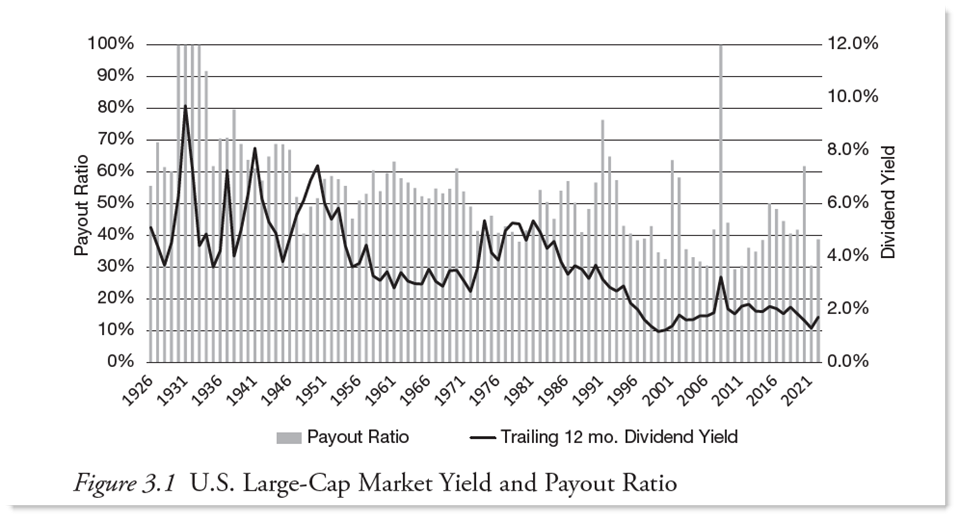
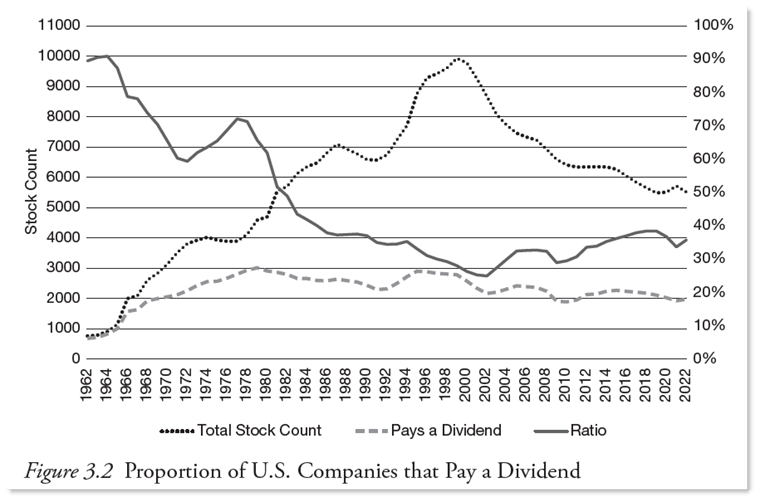
Today capex as a share of sales is lower yet profitability is far higher, and there is minimal inclination to pay dividends; the money goes to buybacks and acquisitions. Two very different market worlds, and few dividends exist for running dividend mandates.
The dominant market philosophy favors stock ownership and contingent manifestations of success over business ownership and tangible ones.
Portfolio construction and duration (Minute 33)
Dividend income should not be 100 percent of anyone’s portfolio; psychologically, people need exposure to “shiny new objects.” Investors might reasonably hold 10 to 30 percent of equity allocations there.
A mature investor 100 percent in an S&P 500 yielding about 1 percent (overwhelmingly contingent return) is, in his view, not prudent.
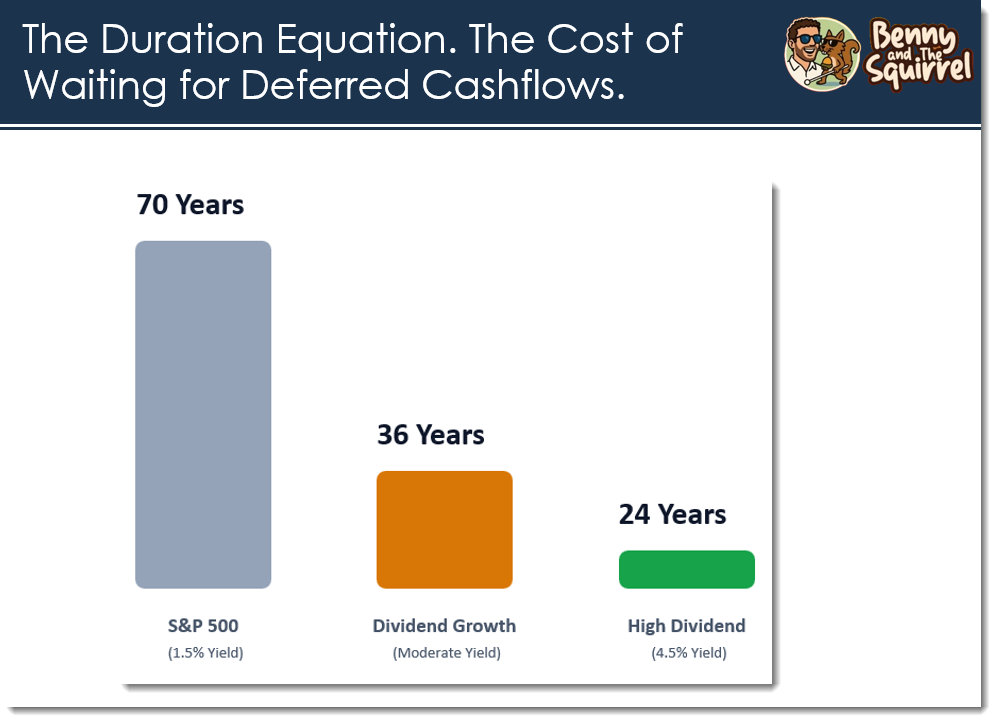
Applied Macaulay-duration logic: a 4 to 5 percent yield portfolio reaches cash payback in roughly 24 years versus about 70 years for a 1 percent yield portfolio, a dramatically different cash-flow profile even beyond the stock-price risk.
AI, trust, and who wins (Minute 35)
Discussion of trust in markets, century bonds as extreme trust (Austria, Google; Benny notes owning a 2117 strip), and declining societal trust possible topic for another day.
Peris critiques the tax deductibility of interest (subject of a recent American Affairs article), arguing U.S. taxpayers are subsidizing Google, Meta, Oracle, and Microsoft’s multi-decade and century bond borrowing to finance the AI data-center buildout.
Among AI vendors, a tiny fraction may win, but his Main Street dividend-paying companies are indifferent purchasers of the technology, seeking productivity gains like prior waves (ERP, SAP, CRM, IBM 360).
He is bullish on AI technology being adopted broadly but wants nothing to do with financing it. The 1840s railways analogy captures the resolution: the technology can be real while the shareholders get wiped out.
S&P 500: “Dr. Frankenstein’s benchmark” (Minute 40)

Peris’s American Affairs essay (previous autumn) applies his method: the S&P 500, created in 1957, was a breakthrough: market-cap weighted, daily (initially hourly) pricing, replacing the 1923 weekly index. The total return version arrived only in 1988.
Today the index has ceased to be a benchmark and is effectively a volatile, growth-oriented investment vehicle that drives rather than measures the market, failing the “observer paradox.”
His estimate from S&P’s 2023 year-end disclosures: up to about 40 percent of index market cap is effectively tied to itself (index funds, closely managed active money with low tracking error, and derivatives), roughly 16 trillion of a then 40 trillion market cap. The yardstick is running the race; Michael Green’s passive-flows critique is, on this front, not wrong.
Russell style indexes and factor chaos (Minute 45)
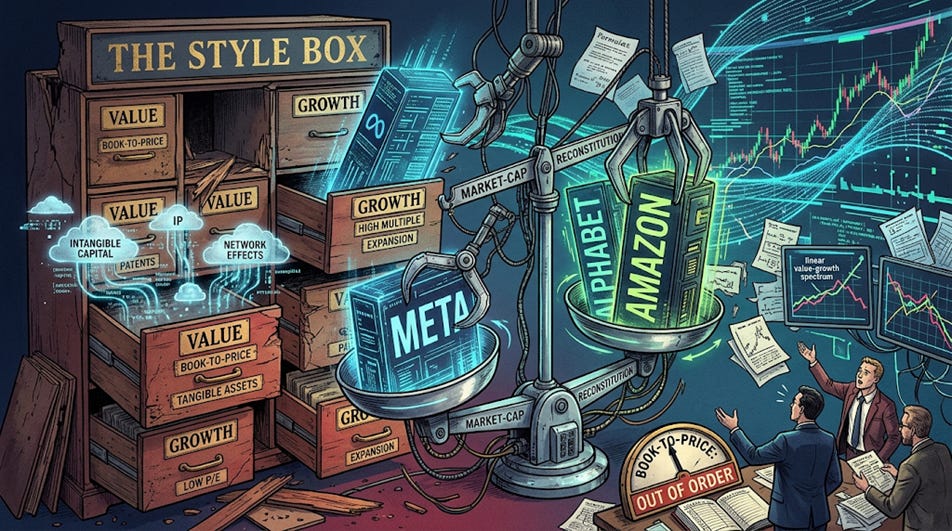
Frank Russell launched the Russell 1000 and 3000 in 1984 (sensible: S&P too small, Wilshire too big), then the value and growth sub-indexes in 1987, which he calls the “original sin.”
Core flaw: forcing value and growth to add to the index conflates price (valuation) with the nature of the business (growth). Value and growth are unrelated dimensions, not a linear spectrum.
Metrics aged badly: price-to-book (1987) is nearly useless today; the 1995 additions (sales-per-share growth, sell-side EPS estimates) are a business metric and an analyst consensus that has no business in a benchmark.
Result: the 2025 and 2026 Russell rebalances produced chaos, around 22 percent of positions flipping, with Mag 7 names shuffling between value and growth indexes, and a large QIS industry built on these flawed buckets. Russell is now reconsidering its methodology, rightly, forty years later.
Russia’s hegemonic decline (Minute 54)

Switching to his Sovietologist roots, Peris frames Russia within the universal rise and fall of hegemons (Paul Kennedy’s overextension logic: Rome, Ottomans, Britain, and dominant companies alike).
Russia peaked as an economic power arguably just before World War I (consistent with its strong pre-revolution market); geopolitically it peaked in the 1960s to 1970s with stability, a buffer zone, and second-power military status.
Cracks appeared in Hungary, Czechoslovakia, Poland, and Afghanistan; the 1990s were chaotic. Putin stabilized the system but in an authoritarian, “very Russian” way.
Georgia, 2014 Ukraine, and the 2022 invasion are read as a declining hegemon trying to hold back the sands of time, expecting a quick absorption of roughly 40 million culturally adjacent people after the U.S. Afghanistan withdrawal.
At 60:00 the argument sharpens: the gambit failed and accelerated decline, drawing on the December 7, 1941 analogy: Japan lost the war the day it attacked, it just took four years. Russia has doubled down similarly, and even a near-term deal would be a Pyrrhic victory given casualties, out-migration, pariah status alongside North Korea and Iran, and near-vassal dependence on China.
Longer-term scenarios (written for Engelsberg Ideas) envisage a literally shrinking Russia, as population and economics can no longer support far-flung territories, more complicated than Britain’s naval retreat from empire because Russia is contiguous, with Kaliningrad the interesting non-contiguous case. Separately, he has covered soft-power losses such as Russian tennis players.
Western policy implication, invoking Napoleon: do not interfere with an opponent making a huge mistake. He declines near-term predictions and keeps his Ukraine views separate, while reiterating the human tragedy there.
If you act on anything provided in this newsletter, you agree to the terms in this disclaimer. Everything in this newsletter is for educational and entertainment purposes only and NOT investment advice. Nothing in this newsletter is an offer to sell or to buy any security. The author is not responsible for any financial loss you may incur by acting on any information provided in this newsletter. Before making any investment decisions, talk to a financial advisor.


