

Episode 98 and another unmissable Sunday Show! The AI trade is getting flushed. But is this the big one, or just another crowded-position unwind? We unpack the widening cracks in AI financing, why booming compute demand does not automatically mean booming revenue, and whether the S&P equal weight’s comeback signals a genuine market rotation.
LLM Watch

Pod Summary
The AI Unwind in Numbers
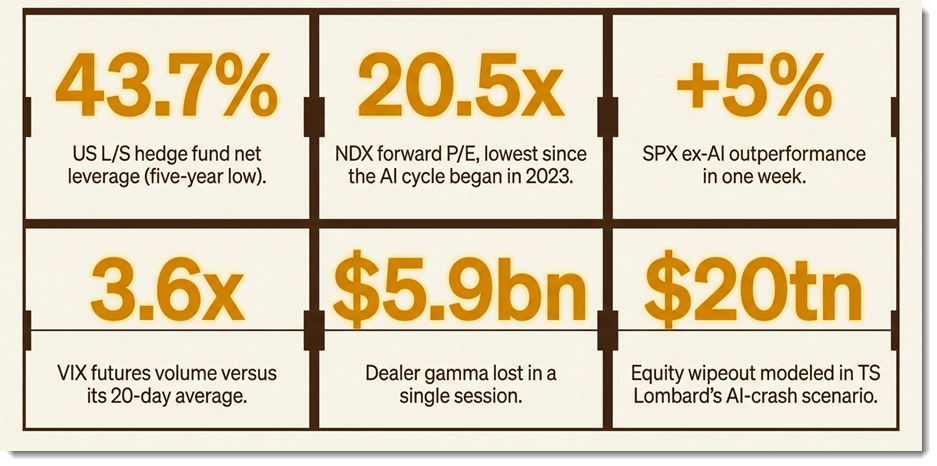
The week’s equity weakness = a sharp reduction in crowded positioning, particularly around AI, rather than clear evidence of a broader market collapse.
This is probably not “the big one”.
Net leverage has been aggressively reduced, with positioning measures reaching the bottom percentiles
Similar to the deleveraging seen from late June into late July.
The damage within AI-related trades has been much more severe than the headline indices suggest
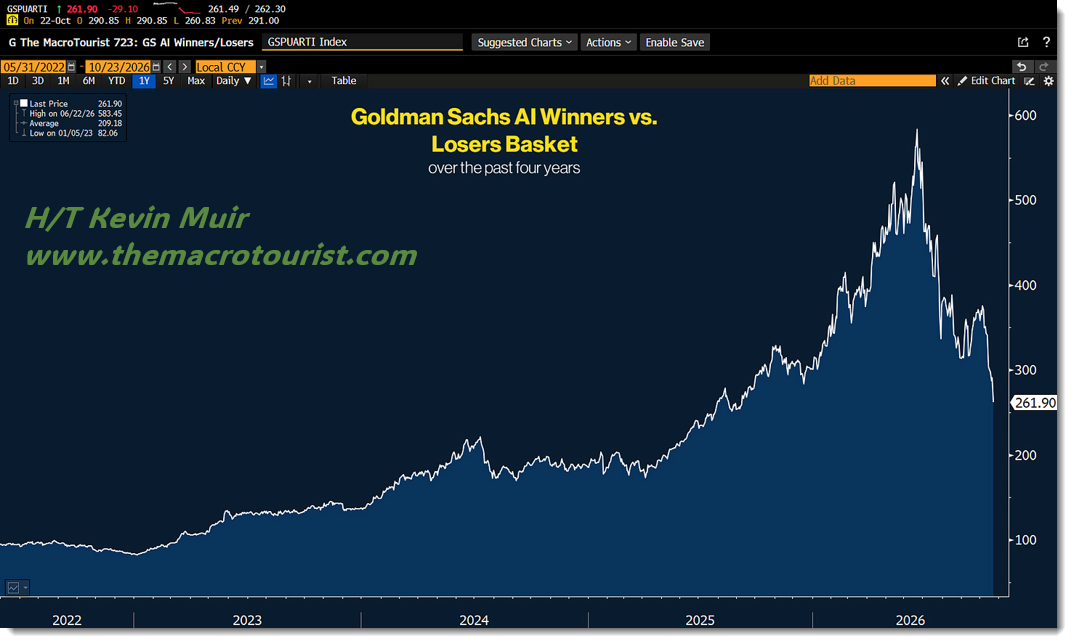
The central distinction is between a modest-looking index drawdown and a substantial collapse in individual speculative trades.
AI financing: competition for capital becomes the constraint
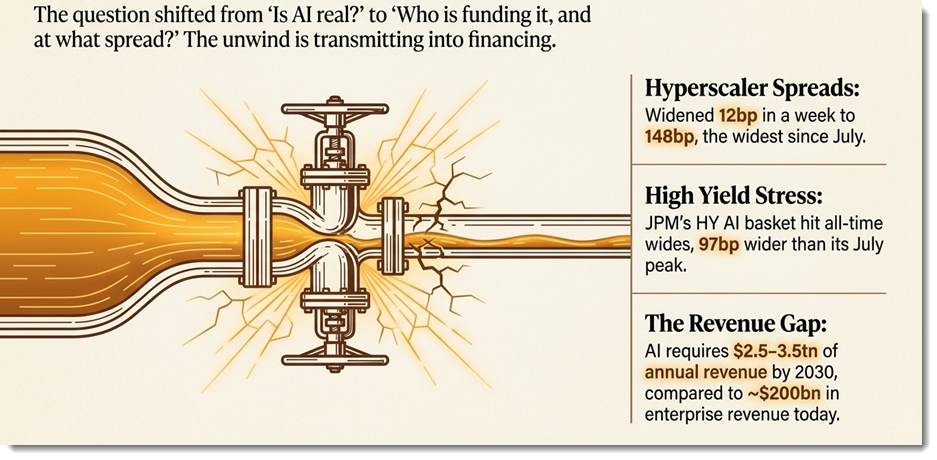
Only a small number of players can compete effectively for credit-market funding.
Is access to financing is straightforward even for the largest companies?
Borrowers are having to pay more.
Beyond a certain point, a higher interest rate may not solve the problem because lenders hit capacity limits.
This creates a potential dividing line within AI: the ability to fund infrastructure may matter as much as the ability to generate demand for it.
AI capex: compute demand is not external revenue (Minute 4)
Is the bullish argument that extraordinary demand for compute, including strong Hopper rental rates, is sufficient to justify AI investment.
Compute demand is not equivalent to revenue.
The relevant question is how much revenue must ultimately come from customers outside the AI industry to support the infrastructure spending.
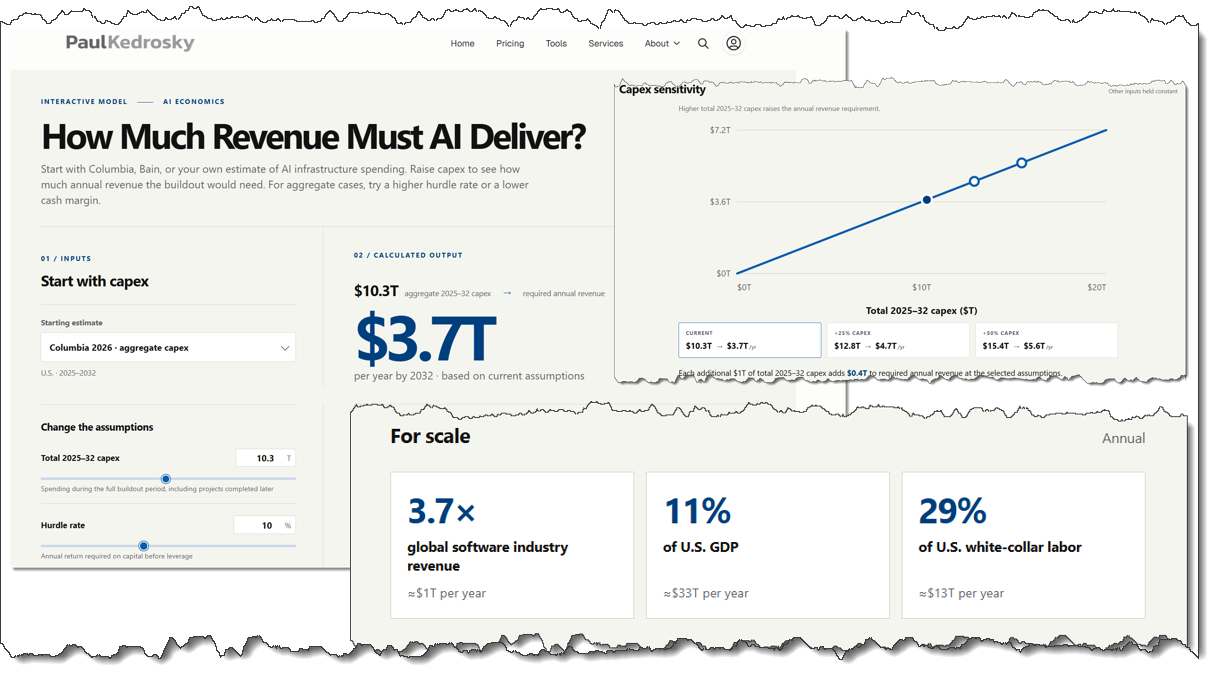
Discussion of Paul Kedrosky’s AI capex revenue hurdle calculator
It translates AI capital expenditure into a required level of external revenue.
It then expresses that requirement relative to GDP, global software revenue and US white-collar salaries.
The purpose is to test whether the economic assumptions behind the investment cycle are plausible.
“Unlimited demand for compute” becomes less useful as an investment proposition unless it translates into real customer spending outside the sector.
Are credit markets are beginning to confront precisely this issue?
AI usage versus spending (Minute 7)
Rapidly rising usage need not produce equally rapid growth in expenditure.
Better routing, system design and optimization can allow usage to grow geometrically while spending flattens or declines.
The key issue is whether customer spending will grow enough to justify the capital already committed.
The strategic motive for continued infrastructure investment.
Large operators may be trying to become indispensable, establish a toll-road position or price competitors out of the market.
In that scenario, the infrastructure owners could retain value even if the model developers face difficult economics.
Own the compute rather than be Anthropic or OpenAI but compute ownership only works if the owner can continue accessing capital markets. That narrows the investable universe substantially.
The hosts compare the possible outcome with a utility-like market in which a small number of dominant providers control access and capture the profits.
What happened to Anthropic’s S-1?
Anthropic’s expected S-1 filing did not appear on Friday.
Delayed disclosure may help preserve the AI narrative.
Once detailed financial information becomes public, investors must assess the actual economics rather than an open-ended story.
Differentiation in private debt markets between OpenAI-backed and Anthropic-backed data-centre projects.
Some OpenAI-linked deals are reportedly not getting done.
Where financing is available, he has heard of differences of approximately 200 to 300 basis points.
He explicitly qualifies these observations as individual data points, not a comprehensive market survey.
The sell-off spreads beyond direct AI beneficiaries (Minute 10)
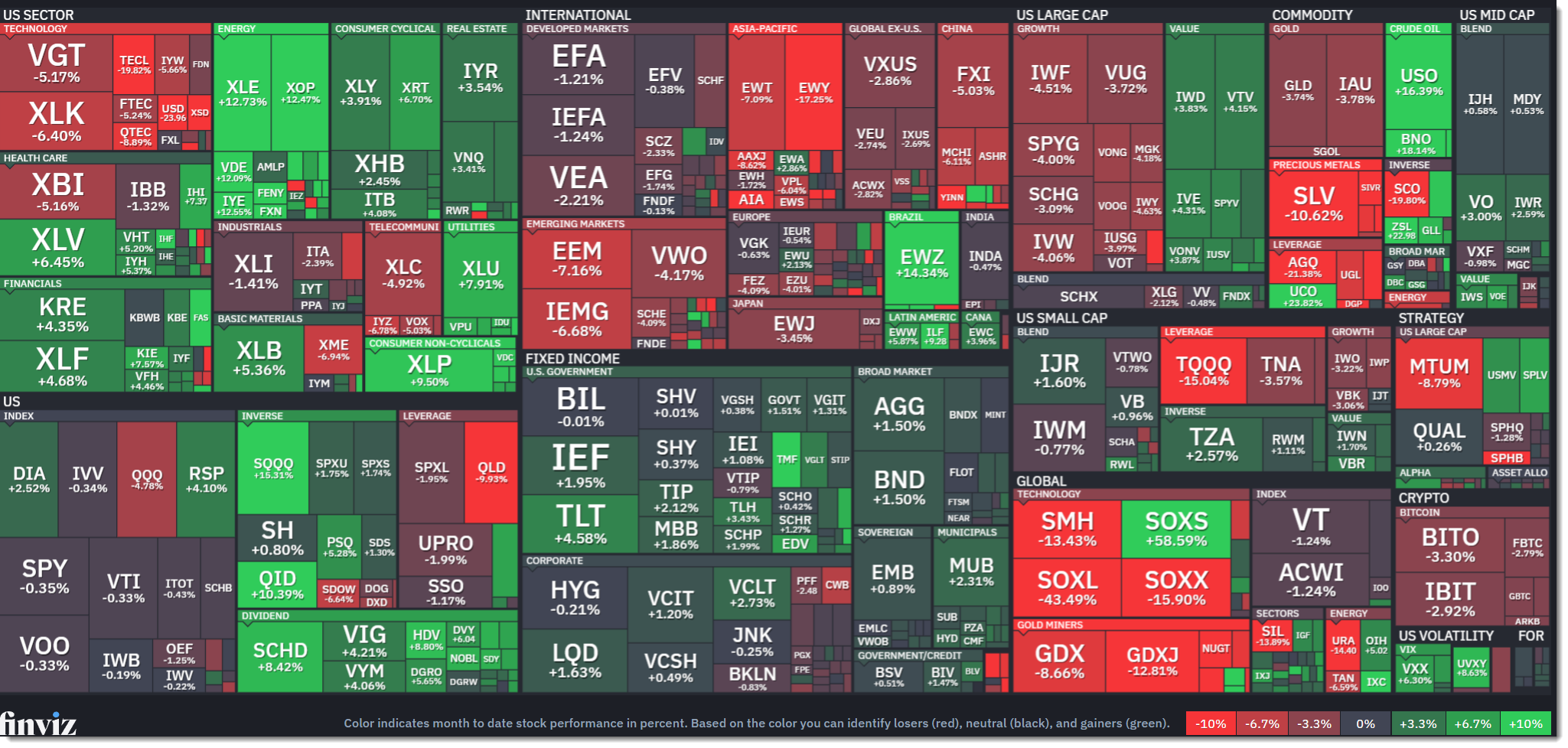
The latest week’s weakness has extended further down the AI-related supply chain.
Copper miners fell nearly 10%. Iron ore miners were also coming under pressure.
The damage is moving from direct AI winners into second- and third-order beneficiaries.
Even traditional value investors are beginning to feel the effects.
He also sees increasing concern about slowing growth and a more stagflationary backdrop.
But do these apparently macro-driven moves simply just instead reflect the mechanics of crowded-position unwinds.
Equal weight S&P versus Nasdaq (Minute 12)
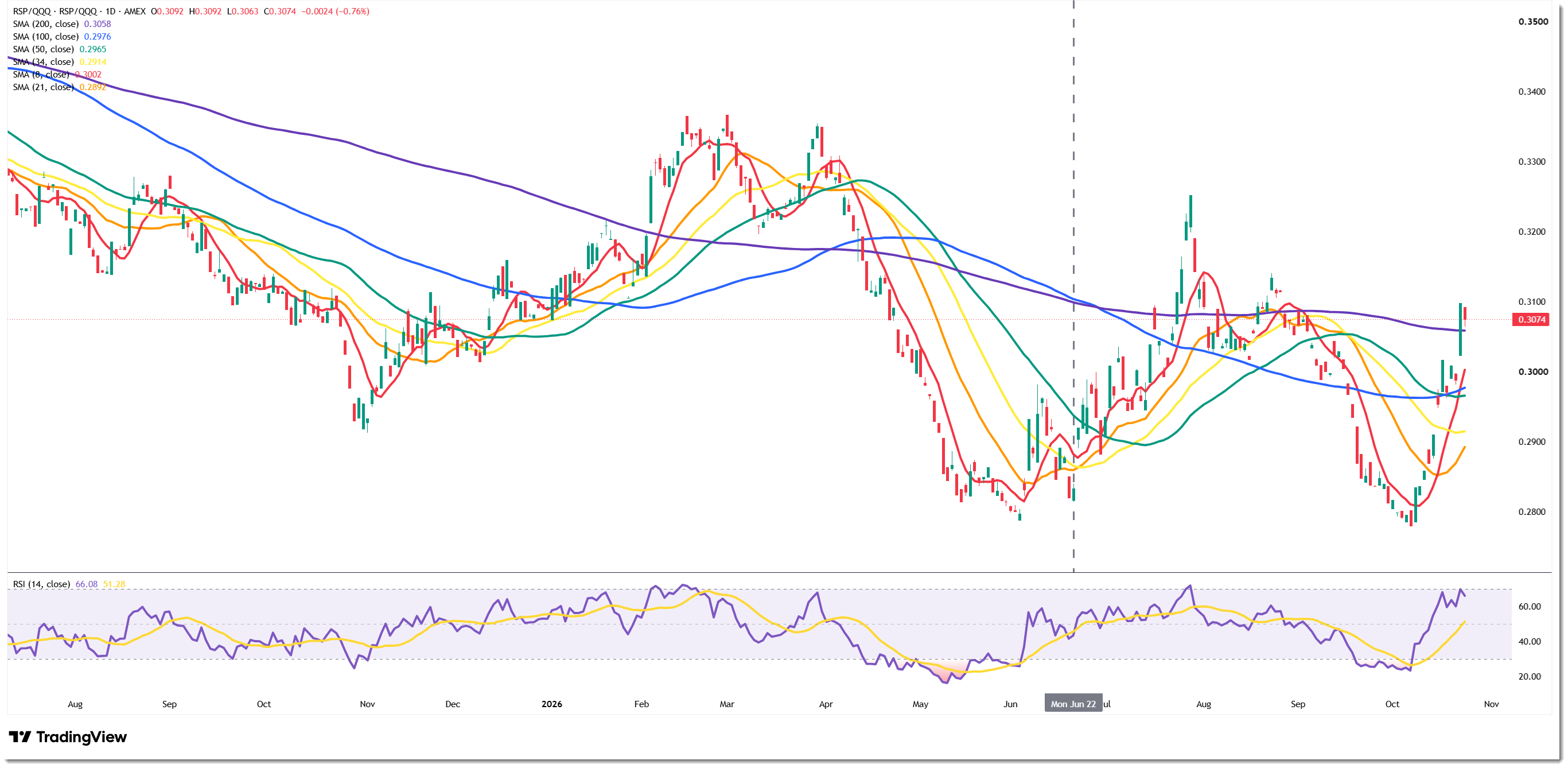
The ratio has staged a striking rebound over past five weeks.
For it to extend, the semiconductors probably need to break down - but the weekly chart still in primary uptrend:
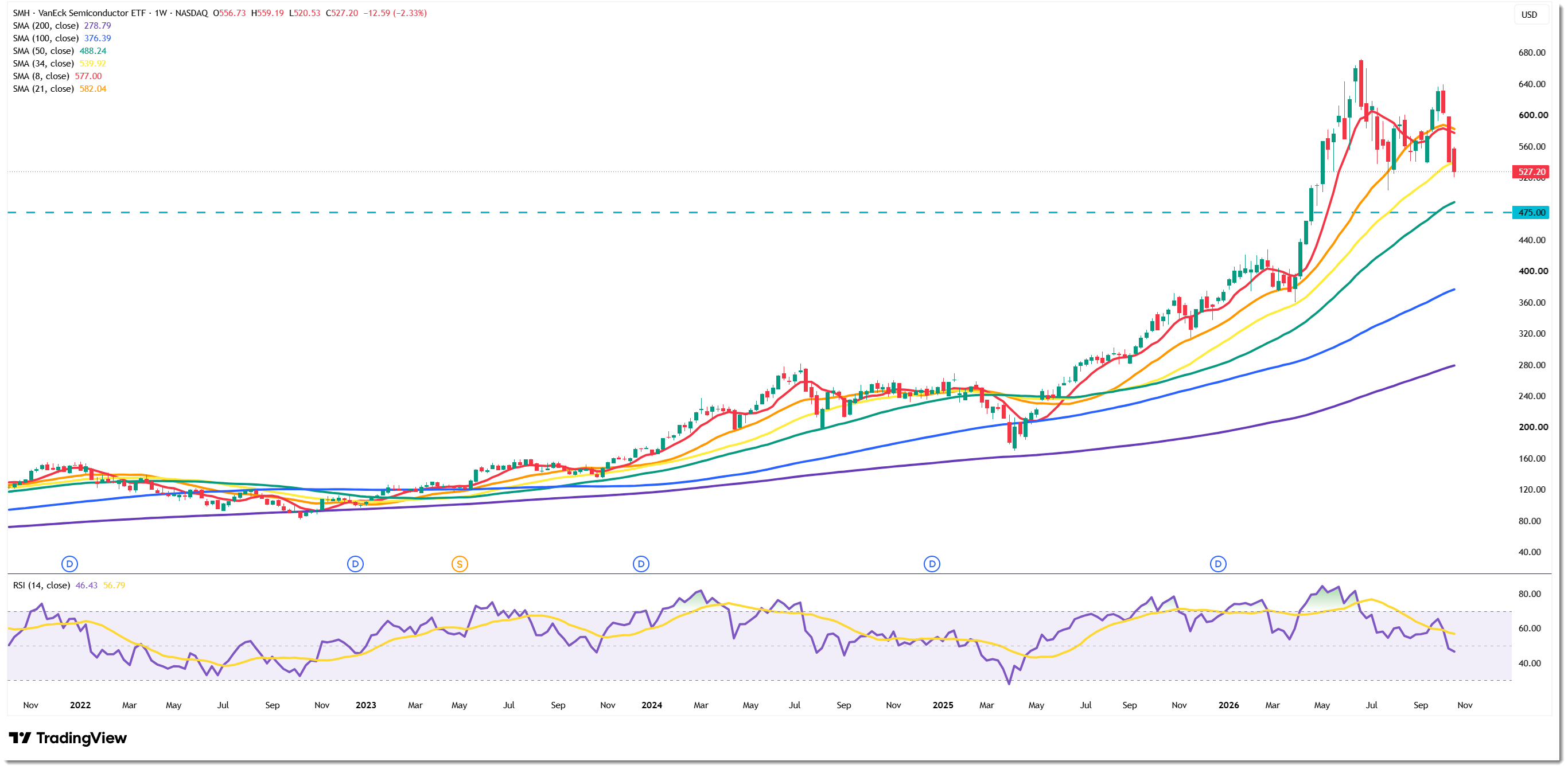
Betting against semiconductors means betting against currently booked revenue and earnings, not just a speculative narrative.
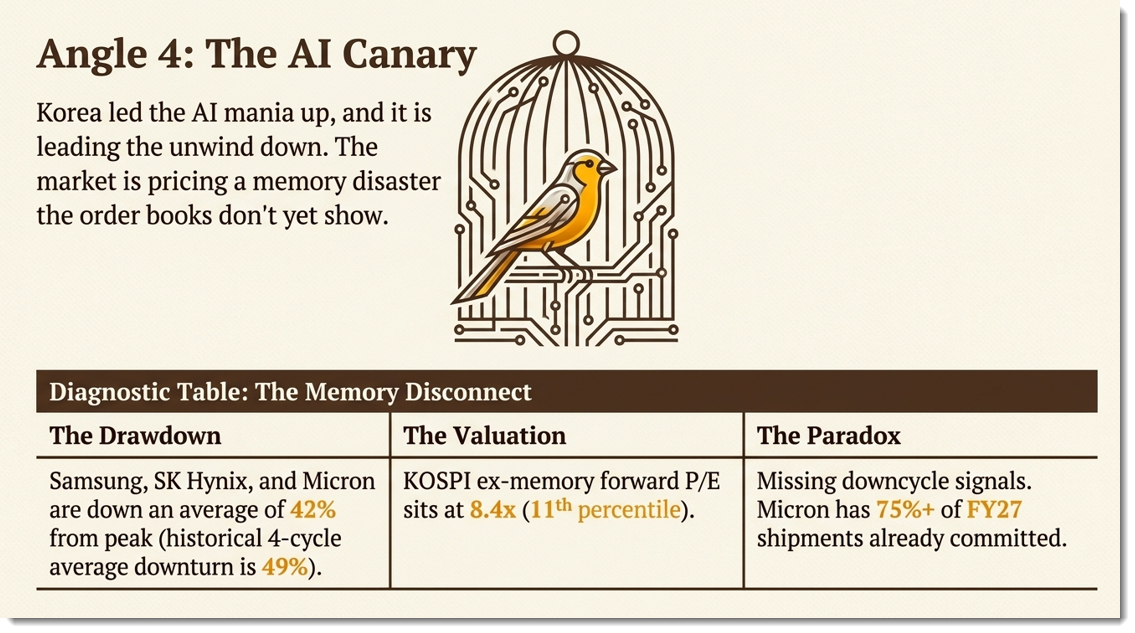
The hosts agree that “cheap” and “expensive” are difficult labels for highly cyclical businesses.
A bullish memory-stock thesis requires a clear view on:
The timing and scale of additional Chinese supply.
How that supply affects pricing.
Whether strong earnings can persist for another year or longer.
Very low multiples could produce attractive returns if current profitability lasts.
However, the thesis ultimately requires confidence in earnings further out, including 2028 and 2029.
The broader point is that the durability of earnings matters more than the apparent cheapness of a single year’s multiple.
Industrials ‘20-for-20’ (Minute 18)

The traditional portfolio role for industrials is challenged in current pricing environment.
Industrials should ideally provide a steady base of compounding businesses.
Many now carry substantial premiums associated with AI infrastructure, electricity constraints or defence spending.
He revisits a hypothetical portfolio built from a 2006 starting point.
A portfolio extrapolating then-current narratives might have owned auto companies, handset manufacturers and GE.
A more successful hindsight portfolio could have included FANUC, Caterpillar and Schneider Electric.
The lesson is not simply to identify good businesses, but to distinguish business quality from the price paid.
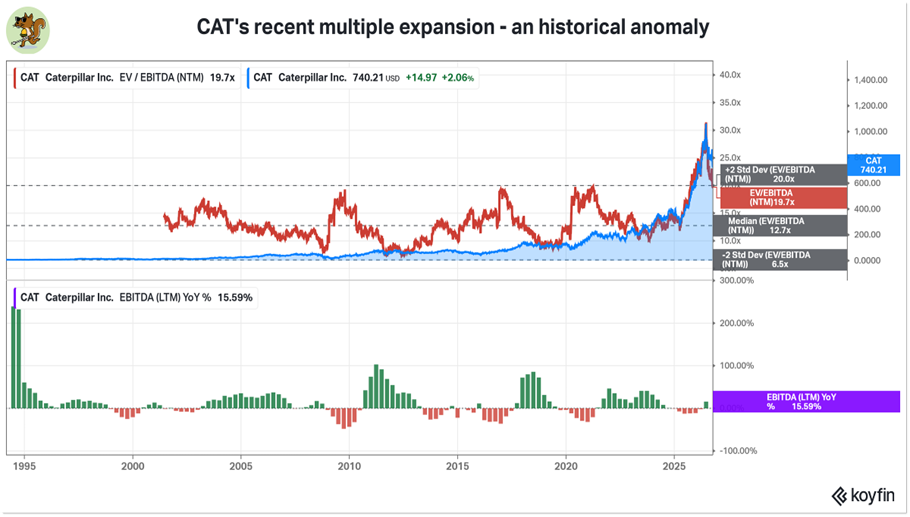
Caterpillar is a classic case study - an “accidental bottleneck stock”.
He sees a similar pattern across industrial businesses connected with physical power constraints or the broader AI theme.
Defense stocks present a related problem.
Their thematic narratives are powerful.
That does not automatically make their starting valuations attractive for a portfolio assembled in 2026.
Gold miner cash generation (Minute 23)
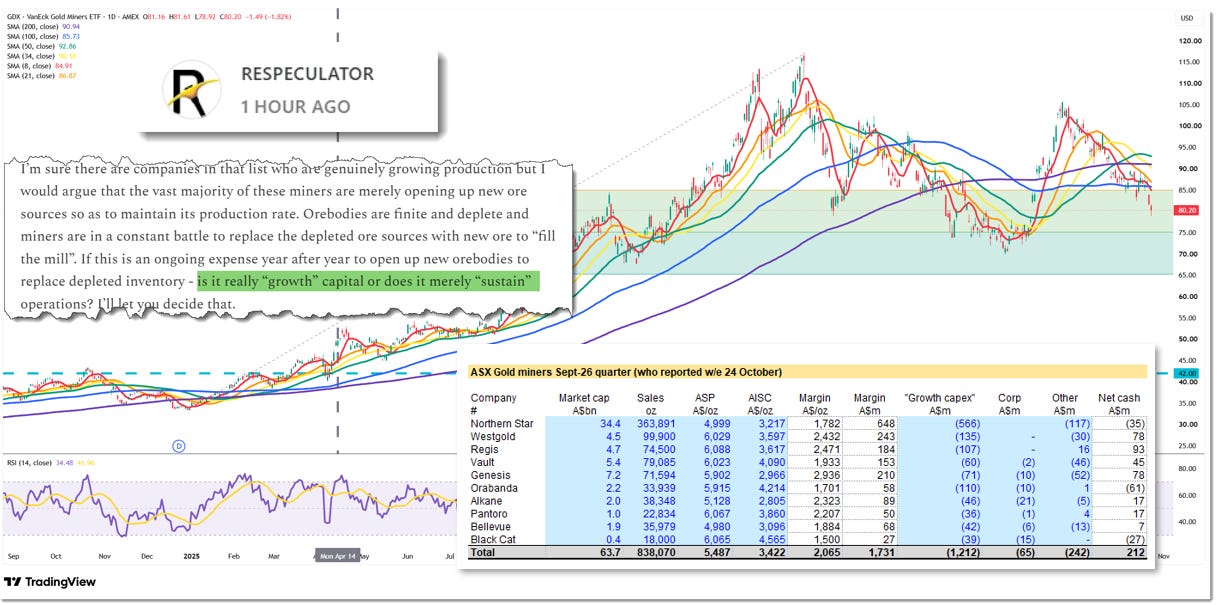
Popular narrative is that gold miners are “printing money” at $4,000 gold.
Some companies may be generating substantial cash.
That does not justify assuming the same economics across the sector or buying GDX indiscriminately.
Discussion of Respeculator research on ASX-listed gold miners.
The spread between gold prices and reported all-in sustaining costs can suggest margins of approximately $2,000 per ounce.
Yet those apparent margins are not consistently appearing as incremental cash on company balance sheets.
A major reason is spending classified as “growth capex”.
Some growth spending, including mine extensions needed to keep mills supplied, is economically necessary rather than genuinely optional.
He draws a direct comparison with AI accounting.
Ignoring model-training costs (‘EBTIT’) flatters the economics of AI labs.
Ignoring recurring mine-development requirements can similarly flatter the economics of gold producers.
The analytical requirement is to identify which companies actually convert high gold prices into cash after all necessary spending.
If you act on anything provided in this newsletter, you agree to the terms in this disclaimer. Everything in this newsletter is for educational and entertainment purposes only and NOT investment advice. Nothing in this newsletter is an offer to sell or to buy any security. The author is not responsible for any financial loss you may incur by acting on any information provided in this newsletter. Before making any investment decisions, talk to a financial advisor.


